

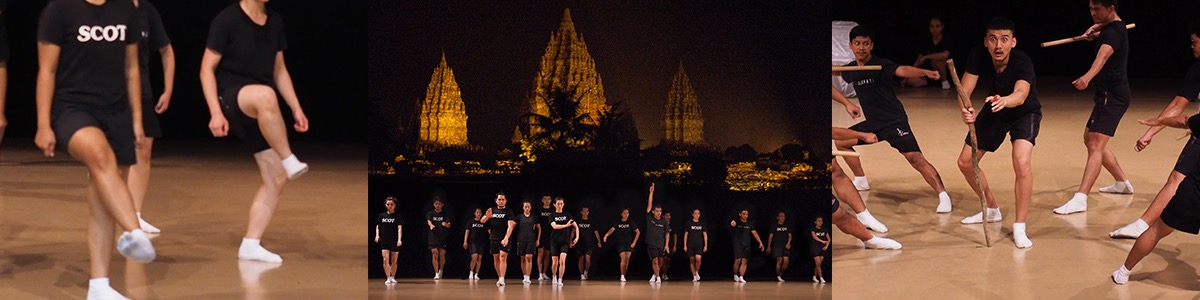


DIONYSUS
Directed by Suzuki Tadashi
Music by Takada Midori
Costume by Suzuki Tadashi and Auguste Soesastro Performed by Indonesian, Chinese, and Japanese actors Text based on The Bacchae by Euripides
This drama is adapted from an ancient Greek tragedy The Bacchae authored by the Athenian playwright Euripides.
Dionysus (God of Wine) intends to punish Pentheus (King of Thebes). So he allures souls of the women in Thebes one by one (including Pentheus’ mother Agave), and then arrives at Mount Cithaeron. Pentheus is also fascinated and directed to the women’s carnival banquet on Mount Cithaeron. However, he is torn to pieces by the admirers. Delirious, Agave carries Pentheus’ head and leaves. She wakes up only to find that her son is dead.
At this time, she is aware that she has become a scapegoat…
PURNATI INDONESIA BRINGS
LOCAL LANGUAGES AND TRADITIONAL MUSIC
IN CONTEMPORARY THEATRE “DIONYSUS”
Purnati means “from the heart” and Purnati is a “movement” that encourages collaboration of art especially among Indonesian young artists. Simply said, artistic endeavour with “Indonesian-hearted” intent. True to its heart, this year, Purnati collaborates with SCOT (Suzuki Company of Toga) to produce Suzuki’s interpretation of Dionysus, but with added distinctive Indonesian flavour.
Dionysus of SCOT – Purnati is directed by Suzuki Tadashi, a theater maestro from Japan and has finished its world premiere at Toga Art Park of Toyama Prefecture (nicknamed “The Mecca of Theatre”), Japan on August 24, 25, 31 and September 1, 2018. On September 29-30, Dionysus are going to have two days special performances in Indonesia, scheduled to be performed at the stage of Open Air Theater in Prambanan Temple.
The idea to collaborate started in 2015 when Mr. Suzuki and the Asia Center Japan Foundation approached Ms. Kusumaningrum with the request that she arranged traditional performances for them to see. Mr. Suzuki was very impressed and invited two groups to participate in Mr. Suzuki’s Festival in Toga in September 2015. The performances were very well-received and that led to agreeing to a collaboration between Purnati Indonesia and SCOT. Purnati was to send Indonesian actors to undergo Suzuki Method of Actor Training directly under Mr. Suzuki supervision to act later in one of SCOT “staple” production. Dionysus was chosen and in 2016 the work began.
Suzuki Method of Actor Training is considered one of world’s best actor training method. It is a rigorous and highly physical method of acting training. This intensive course serves to strengthen an actor’s physical and vocal sensibilities, developing a highly articulate body capable of expressing and communicating with power and precision.
In June 2016, the first auditions was held in Jakarta. Forty eight actors from theatre groups across Indonesia came, and only sixteen were chosen to go to Toga. Some of the actors who came for the first audition might had heard about Suzuki Method, but none could know what was coming. In Toga, those actors for the first time experienced basic Suzuki Method under tutelage of Mr. Suzuki’s assistants. They were quite in shock of the rigorous and strenuous method and had a glimpse of a very demanding, yet rewarding training process at least three years into the future. After two weeks (August 31 – September 14, 2016), they returned home for the second audition in Bali and only thirteen were selected to continue an intensive period of rehearsal in Jakarta prior to returning to Toga to rehearse directly under Mr. Suzuki (April 19 – May 7, 2017). They returned home and at October 6 – 26 they went for another training session in Bali and Prambanan.
Actor training aside, another creative and artistic activities also took place. Japanese composer Takada Midori came to Indonesia to take sampling from various traditional music instrument to be added to the original score of Suzuki’s Dionysus; a fleeting, but distinctive Indonesian flavour was added. Auguste Soesastro, a young Indonesian designer, was also approached to design some costumes for the performance. He was asked to create costumes for the six priests and Cadmus; the brief was all white with Indonesian traditional textiles.
The most important Indonesian element added to this collaborative effort was the use of six Indonesian vernacular languages spoken during the play. When first translated in Indonesian, somehow it did not sound very convincing, only when the idea of each actors should speak in their mother tongue, a very powerful effect was felt. Mr. Suzuki’s philosophy of “body is the culture” suddenly made sense. He said
[…j The actors all speak in their mother tongue. I accepted this and
something unique happened. I might not understood it, none of us
did, (but) I could feel different rhythms, colours, and sounds […j 1
On March 4-23, 2018, Toga was still blanketed in heavy snow, but it did not stop 14 actors, including the understudy from third audition, to rehearse for three weeks. In addition to repeating the rehearsal in Prambanan, the actors also rehearsed wearing the new costumes with new musical compositions already enriched with Indonesian traditional instruments, among others: gendang rapai from Aceh, Balinese gamelan, Minangkabau serunai, Sundanese kecapi, and multiple flutes.
SCOT – Purnati’s Dionysus is certainly a unique artistic collaboration, Indonesian actors are going to perform alongside a Chinese and a Japanese actors. A total of eight spoken languages: Japanese, Mandarin, Batak, Rejang, Madurese, Manado, Sundanese, and Javanese in three dialects — Jogjakarta, Surakarta, and Banyumas. A myriad of Indonesian traditional instruments and sounds woven beautifully into the original score. In the same stride, traditional woven textiles are worn to create certain charisma to enhance the already powerful production.
Dionysus was chosen by Purnati, because Mr. Suzuki’s interpretation of Dionysus sent a powerful, yet universal message to the situation of the world nowadays. The play is adapted from an ancient Greek tragedy, The Bacchae, written by the Athenian playwright Euripides. Dionysus (God of Wine) intends to punish Pentheus (King of Thebes), so he allures souls of the women in Thebes one by one, including Pentheus’ mother Agave, to Mount Cithaeron. Pentheus is told about this, he becomes fascinated and follows the women to their carnival banquet on Mount Cithaeron. Driven wild by his intrusion, the women tore and ripped his body apart, piece by piece. Delirious, Agave carries Pentheus’ head and leaves. She wakes up only to find that her son is dead. At this time, she is aware that she has become a scapegoat.
After much toing and froing, Indonesia and Japan, at last on 1st August, 2018, 13 actors and one understudy went to Toga getting ready for the world premiere scheduled on August 24, 25, 31 and September 1. After nearly three years of very intensive training, these Indonesian actors who had changed and grown so much both mentally and physically, were ready to take the Toga Grand Theatre Stage. Their relentless routine of Suzuki Method training and rehearsal from morning to a few hours before taking the stage, not to mention the applied mental and self-discipline, had managed to banish all thought of stage fright. Before facing the audience, these actors had to put on their own make up, dressed themselves up in costumes, and even helped to prepare the stage. Everyone was fully realized to become a Suzuki Tadashi trained actor, it was meant to dedicate one’s life to the sacredness of theatre as the holiest temple. When the fully packed theatre for all four performances broke in applause after each performance, these actors knew they still had one big challenge in front of them: two special performances under the grand silhouette of the Prambanan temple. Is Indonesia ready for a world class performance?
DIONYSUS is directed by Suzuki Tadashi
Produced by Suzuki Company of Toga and Bumi Purnati in partnership with The Bali Purnati Centre for the Arts
This joint production is supported, in part, by TYO First Edition, PT. YKK Zipper Indonesia, PT. YKK Zipco Indonesia, PT. YKK AP Indonesia, and Losari Foundation for production in Indonesia and The Asia Center Japan Foundation for production in Japan.
1 taken from: – http://www.scot-suzukicompany.com/blog/suzuki/2018-08/